Do it all with Devin: Announcing our Series E
Cognition has raised over $2B at a $48B valuation. The round was led by new investors Andreessen Horowitz and Accel, alongside existing investors Founders Fund, General Catalyst, and Avenir. Other investors in the round include Benchmark, Bessemer, Kleiner Perkins, Greylock, Lightspeed, Altimeter, Bond Capital, Meritech, Atreides, Valor, T. Rowe Price, Lux, 8VC, D1, 137 Ventures, DST, Positive Sum, HOF, Soma, BoxGroup, Battery, Ribbit, Swish, Stripes, Definition, Hanabi, Journey, Bain Capital Ventures, Layer Global, A* Capital, Alpha Wave, Alkeon, and Diffusion.
Software shapes nearly every aspect of modern life. Yet the world’s demand for software far exceeds our capacity to build it. Even the most ambitious, well-resourced teams leave products unbuilt, postpone critical upgrades, and allow vulnerabilities to go unaddressed because engineering time is finite.
We started Cognition in 2024 to change that and build the future of software engineering. We believed engineers should operate more like architects and delegate execution to swarms of agents. Together, engineers and their Devins could dramatically expand the world’s capacity to build great software and solve hard problems.
Since our last round in May, Cognition’s run-rate revenue has grown from $492M to almost $900M. As Devin becomes an essential part of how companies build software, customers throughout the economy are rapidly expanding their adoption. Devin works with the world’s leading companies, powering engineering teams across chip design at NVIDIA, aviation at GE Aerospace, financial services at Citi, automotive at Mercedes-Benz, and AI infrastructure at Modal.
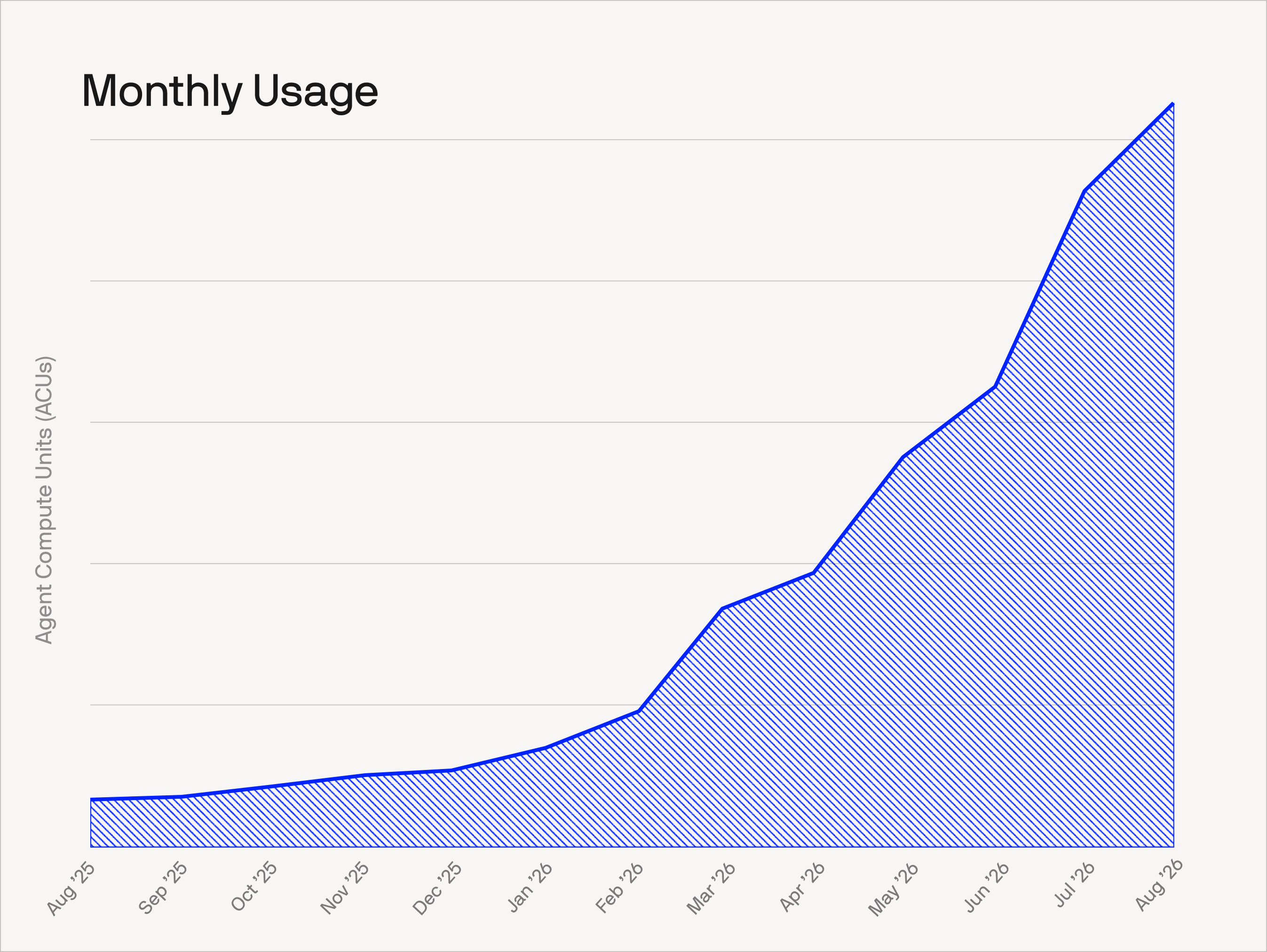
Across all surfaces, Devin is now able to take significantly more directed, yet proactive action. Devin Auto-Triage can take a first pass at incident investigation. Devin Security Swarm finds and triages vulnerabilities. Devin Automations let teams configure work to begin from events in Slack, GitHub, Linear, and other systems, without opening a chat for each task.
We’re still at the dawn of the self-driving software era. In this next chapter, agents will become proactive by default, software will improve itself, and even resource allocation will become intelligent as compute budgets self-allocate toward the highest impact use cases. Human engineers will increasingly act as architects, setting goals and priorities while agents take on more of the work to achieve them.
Getting there takes a deep understanding of a company’s systems and processes. It’s why we work side by side with our customers wherever in the world they are. In the past year, we’ve opened offices in Washington, D.C., Tokyo, Singapore, London, São Paulo, and Madrid, in addition to our San Francisco, New York, and Austin hubs. The list will keep growing.
It is also why we are building Cognition as an independent agent lab. We can choose and combine the models best suited to the work, including our own, rather than tie customers to one provider.
There is far more software worth building than the world can build today, and we intend to change that. Come change it with us.