Jorge
Zreik
Member
of
Technical
Staff

Everyone on Cognition’s engineering team, from product to research, has the same title: Member of Technical Staff. That’s partly because our org chart changes too quickly to keep up with. Engineers work in small pods of four to eight people built around the most important problems at that moment.
My role has evolved with the problems I’ve wanted to solve – from improving our UI and new user experience to shipping security scans in Devin Review and dreaming up new Cloud session features. Things move too quickly here to wait for reporting lines and job titles to catch up.
Every second counts, so we organize around the work, not the other way around.
I work on our Cloud Product team, building the apps that make Devin cloud agents easy and effective to use. The hardest place to get that right is at the world’s largest enterprises. Making Devin good at that scale isn’t something you can do entirely from the New York office where I sit (though Kit, our NY office manager, makes it hard to leave). You have to see how customers actually use the product.
That’s how I ended up in Madrid with our Customer Engineering team supporting a large financial services customer earlier this year. “Member of Technical Staff” didn’t come with the expectation to visit customers by any means, but I spoke Spanish, knew the respective account team well, and wanted to hear customer feedback first hand.
The first thing I noticed in Madrid was how many screens had Devin on them. It was the main window on nearly every desk, all day.
That’s when it hit me: Devin was no longer just a tool these teams were trying out. It was infrastructure they depended on. If Devin went down, their work did too. That’s the scale and responsibility we’re building for now.
But their experience with Devin looked very different from ours. Their enterprise security requirements, infrastructure constraints, and sheer scale of usage introduced entirely new challenges. One workflow had accumulated nearly 10,000 child sessions, making Devin painfully slow. From my dashboard in New York, it looked like a slow query. In Madrid, it was a room full of engineers unable to get work done.
I brought what I learned back to the eng team, and we launched a major performance sprint. We made every optimization we could to make the app fast and keep it running smoothly even under massive load. Soon, page loads were 63% faster, streaming freezes dropped 78%, and the most frequent query in the app fell from 5.2 seconds to just 0.29. The bottlenecks we found by putting engineers in the room with one customer made Devin faster for every single user.
Helping the world’s most impactful companies push the frontier of what software can do is the best part of this job. It has not gotten old yet, and I can’t imagine it will.
Eight months and a company-wide performance sprint later, I’m glad we can say Devin is actually good. Still got a long way to go, though!
We use Devin for nearly everything internally. Today, 98% of code at Cognition is committed by Devin. But beyond shipping product features, Devin does it all. My favorite use case is #devindash, where the team uses Devin in Slack to request DoorDash orders to the office. Just last week, a Dasher walked up to Kit and asked, “Order for Devin?”. Devin now knows to include the requester’s name, not his own :)
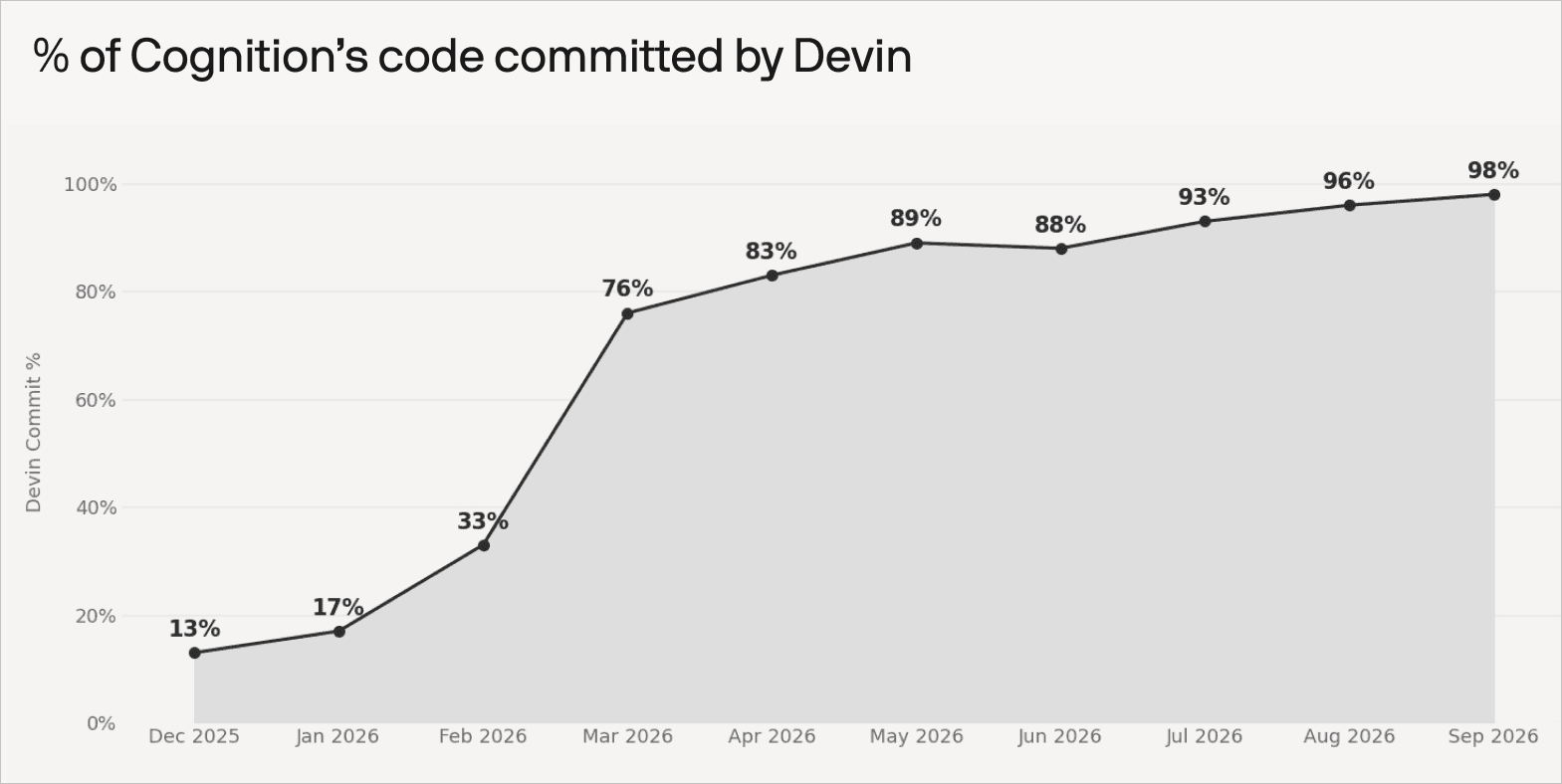
At Cognition, engineers use Devin to push what’s possible with software in ways that would have sounded crazy not long ago. But dogfooding can only take us so far. My first customer visit showed me that our customers operate at a different scale, with different systems and constraints, and it’s our job to bridge that gap.
That means working closely with our GTM and Deployed Engineering teams and, often, sitting directly beside the customer. They bring us into the environments where Devin has to succeed, and we turn what we learn into a better product for everyone.
The future might begin with something crazy we build for ourselves. But our job is to make it work for the rest of the world.